By Analyst Team · Updated 2026-08-09 · 12 min read
What Is IPTV and How Does It Work?
IPTV stands for Internet Protocol Television. Instead of receiving TV signals through cable lines, satellite dishes, or over-the-air antennas, IPTV delivers live channels and on-demand video over your broadband internet connection. The system shown above — a streaming box wired into a fast home network — is the most common way people experience IPTV today.
In simple terms, television content is encoded into IP packets, sent across the internet, and reassembled by an app or set-top box on your TV. You only pull the channels and videos you actually want, when you want them. That single shift — from broadcast delivery to on-demand internet delivery — is why IPTV can offer thousands of channels for a fraction of cable's price.
IPTV isn't one technology but a family of services:
- Live IPTV — real-time broadcasts delivered over IP, just like traditional TV but through the internet.
- Video on demand (VOD) — a library of movies and shows you can stream instantly.
- Time-shifted TV — catch-up and start-over features that let you rewind or rejoin a live show.
Supporting systems like middleware (which manages accounts and channel lists), EPG data (the on-screen program guide), and CDNs (servers distributed across regions) all work together behind the scenes to make the experience feel seamless.
Quick answer: IPTV is legal, internet-delivered television that can replace your cable bill for most households. If you have stable broadband at 25 Mbps or higher, it's worth serious consideration.
LIMITED TIME AVAILABILITY
Unlock Full how does iptv work Access
Secure special promotional rates instantly before the window closes. Lock in your pricing model today before plans return to standard regional metrics.
How Does IPTV Work Step by Step?
To understand how does IPTV work technically, think of it as a content delivery pipeline with six stages. Each stage must run smoothly for a glitch-free picture.
Step 1 — Content acquisition. The provider captures source feeds from broadcasters, studios, and satellite uplinks in professional data centers. These raw feeds are usually received as unencrypted SDI or MPEG-TS signals.
The premium 4K IPTV stream shown above is the final product of this entire pipeline. Step 2 — Encoding and transcoding. The provider compresses raw video using codecs like H.264 or H.265 (HEVC), then packages it into small IP packets. Transcoding converts the video into multiple bitrates and resolutions so it plays smoothly on smart TVs, phones, and low-powered streaming sticks alike.
Step 3 — Streaming protocol delivery. Packets travel over the internet using HTTP-based protocols such as HLS or DASH. Most commercial IPTV services use unicast: a dedicated stream is sent to your device only when you change to a channel. That's exactly why the moment you press "switch," you see the new channel in under two seconds.
Step 4 — Authentication and middleware. The middleware server verifies your subscription, unlocks your channel package, and pushes your personalized channel list and EPG data to the player app.
Step 5 — Device playback. The player app buffers a few seconds of data, decodes the packets, and displays the video. If the buffer empties because your connection or the server slows down, you see the dreaded spinner — which is what every IPTV buffering fix guide is ultimately solving.
Unlock complete high-definition information and priority access packs.
Claim This Special Offer for how does iptv work →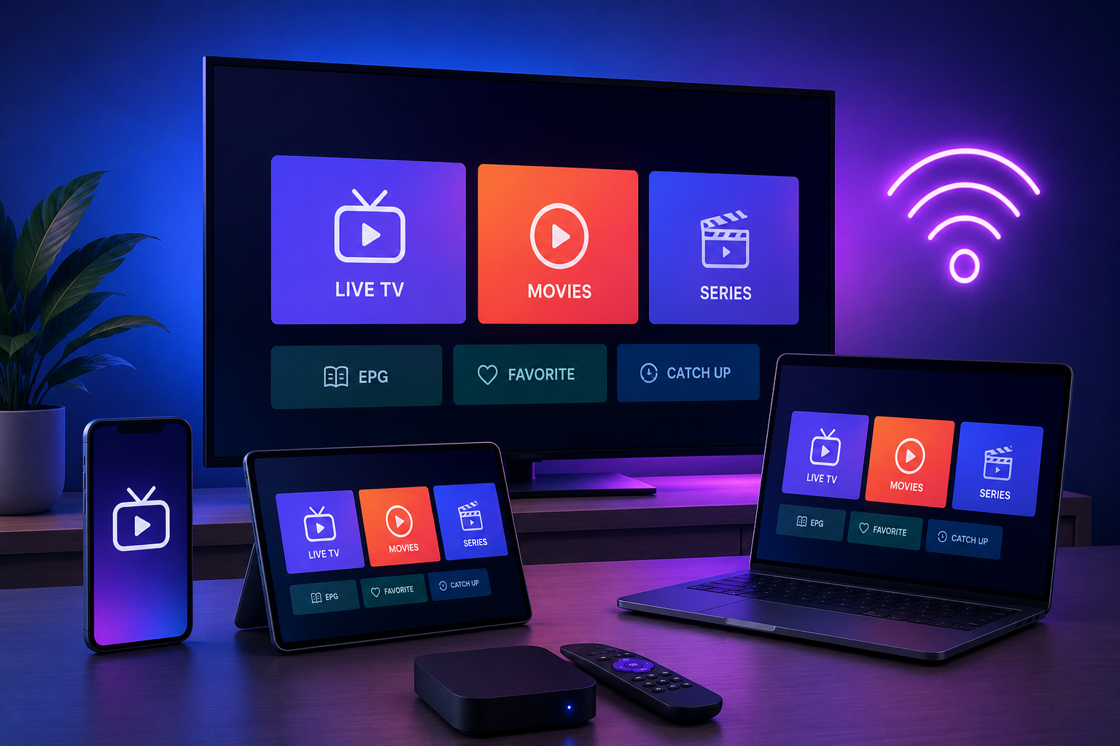
Concrete Benefits of IPTV
The modern IPTV interface shown above gives you a real sense of the flexibility involved. Beyond the pretty menus, households switch to IPTV for measurable advantages:
- Price: IPTV subscriptions typically cost between $10 and $25 per month, compared to $80–$150 for cable bundles.
- Channel variety: Most services offer 5,000 to 20,000+ channels, including international, sports, news, movies, and adult channels.
- Multi-device support: Watch on smart TVs, Fire TV Sticks, Android boxes, tablets, phones, and computers — often simultaneously.
- Built-in VOD: A full movie and series catalog is usually included in the same subscription.
- No long-term contracts: Month-to-month pricing means you can cancel anytime without early termination fees.
- Portability: Your subscription works anywhere in the world where you have internet access — ideal for travel and expats.
Honest Limitations and Risks
A credible complete guide must also cover the downsides of IPTV. Here are the real ones:
- Internet dependency. You need at least 25 Mbps for smooth HD and 50+ Mbps for 4K. A single slow evening can ruin a match or movie.
- Legal gray area. Many IPTV services resell premium channels without broadcasting rights. If you're in the US, this raises the question "is IPTV legal in the US" — the answer depends entirely on the provider.
- Buffering and instability. Cheap, oversold providers buffer heavily during peak hours (7–10 p.m.).
- Provider reliability. Subpar services disappear overnight, sell your data, or stop updating their EPG.
- Customer support. Most IPTV providers only offer WhatsApp or Telegram support, not phone lines.
- Frequent playlist maintenance. Channels and streams die, and the provider must actively repair them.
Pros and Cons at a Glance
✅ Pros
- Massive channel selection
- Low monthly cost
- Multi-device flexibility
- No contract lock-in
- VOD bundled in
- Works while traveling
❌ Cons
- Needs stable high-speed internet
- Legal ambiguity with many providers
- Buffering at peak times
- Provider may vanish overnight
- Weak customer support
- EPG inaccuracies
IPTV vs Cable vs Satellite vs Streaming Apps
The common question "IPTV vs cable which is better" doesn't have a single answer — it depends on your internet connection and viewing habits. This table compares the four main ways to watch TV:
| Criterion | IPTV | Cable | Satellite | Streaming Apps |
|---|---|---|---|---|
| Monthly cost | $10–$25 | $80–$150 | $60–$120 | $3–$20 per service |
| Channel lineup | 5,000–20,000+ | 200–500 | 300–600 | 50–500 (regional) |
| Internet required | Yes (25+ Mbps) | No | No | Yes |
| Contract | None or 1–12 months | 12–24 months | 12–24 months | Monthly / annual |
| Devices | Smart TV, phone, PC, box | Proprietary box | Satellite receiver | Per-app device limits |
| 4K & multi-screen | Often included | Extra fees | Extra fees | Limited |
| Licensing | Mixed by provider | Fully licensed | Fully licensed | Fully licensed |
The verdict: for budget-focused viewers with a decent internet connection, IPTV wins on value and flexibility. For households with unreliable broadband, cable and satellite remain the safer fallback.
Who Is IPTV For?
IPTV isn't for everyone, but it fits several common profiles well:
- Cord-cutters — people tired of ever-rising cable bills who want premium channels at lower cost.
- Sports fans — many IPTV services prioritize live matches, PPV events, and multi-angle sports channels. If you're searching for the best IPTV service for live sports, the core selling point is a provider with solid server capacity during big events.
- Ex-pats and internationals — watching home-country news, drama, and live TV from abroad is one of IPTV's most beloved use cases.
- Budget-conscious families — combining IPTV with free platforms like Pluto TV can fully replace a $130 cable bundle for under $20.
- Travelers and RV owners — as long as Starlink, mobile data, or campground Wi-Fi is available, IPTV works anywhere.
IPTV is not for people with internet speeds below 10 Mbps, users who insist on fully licensed content, or viewers who avoid sideloading apps and configuring playlist URLs.
How to Get Started with IPTV
Getting IPTV running on your TV or device takes under 15 minutes. Follow these practical steps:
- Test your internet speed. Run a speed test at fast.com. For HD, aim for 25 Mbps; for 4K, 50 Mbps or higher. Prefer Ethernet or 5GHz Wi-Fi over 2.4GHz.
- Choose a reputable IPTV provider. Look for one with a trial period, at least a year of consistent operation, and a CDN with servers near your region. Searching where to buy reliable IPTV subscription often surfaces Reddit threads and review blogs like this one.
- Pick your device. The Amazon Fire TV Stick is the most popular IPTV device. Android TV boxes, smart TVs with webOS/Tizen, iPhones, Android phones, and PCs all work too.
- Install a player app. TiviMate, IPTV Smarters, IBO Player, and VLC are the most common. On Firestick, you'll need to enable Apps from Unknown Sources and use the Downloader app to sideload them.
- Enter your credentials or M3U URL. The provider sends a username, password, and server URL (or a .m3u playlist link). Paste these into the player app.
- Add your EPG link. In the app settings, add the EPG URL so the channel guide shows accurate program schedules.
- Connect a VPN. A VPN prevents ISP throttling and adds privacy, particularly in regions where IPTV is legally restricted.
- Troubleshoot proactively. If buffering appears, switch DNS to 1.1.1.1, raise buffer size to 1000–2000ms, lower resolution to 1080p, and test different server portals if your provider offers them.
Conclusion
IPTV changes the economics of television — when you know how it works, you can spot bad providers, fix common problems, and build a setup that matches your viewing style for a fraction of cable's cost. The flexibility, channel variety, and portability are genuinely unmatched. The one variable that separates a great IPTV experience from a frustrating one is the provider's infrastructure. Start with a trial subscription from a service with strong server coverage in your region, pair it with TiviMate or IPTV Smarters, and test it during a live match. If the stream holds up, you've found your long-term winner.
Final Subscription Window:
subscription link Today →Affiliate Disclosure: Clicking this secure link verified by our network supports our team through standard partnership terms at zero extra cost to your invoice.
Frequently Asked Questions
How does IPTV work on a smart TV?
Smart TVs run IPTV player apps directly on their built-in platforms—webOS, Tizen, Android TV, or Roku. You install an app like IPTV Smarters or TiviMate, enter your provider's server URL or scan the M3U playlist, and the app pulls the channel list, EPG data, and video streams over your home internet. The TV's processor handles decoding, so no extra box is needed. The main catch is that app stores sometimes block IPTV apps, requiring sideloading from an APK file.
Is IPTV legal in the US?
IPTV itself is completely legal — Hulu + Live TV and YouTube TV are both IPTV services. The legality question applies to unlicensed providers that resell premium channels without permission from broadcasters. Subscribing to such a service is technically copyright infringement, though US authorities rarely pursue individual viewers. To stay safe, choose a fully licensed provider or use a VPN for privacy while streaming from gray-market services.
What is the best IPTV service for live sports?
The best sports IPTV service is one with abundant server capacity, 4K and FHD sports channels, multi-screen support, and reliable EPG data for kickoff times. Providers that offer a 24-hour trial are your best testing ground — use it during a big match and watch for buffering at peak demand. Some established services stream major leagues like Premier League, NBA, NFL, UFC, and Serie A across dedicated sports portals. Check current user reviews, including IPTV review Reddit 2025 threads, before committing.
How to set up IPTV on Firestick?
First, enable installation from unknown sources by going to Settings > My Fire TV > Developer options and turning on Apps from Unknown Sources. Install the Downloader app from the Amazon store, use it to download an IPTV player APK like TiviMate or IPTV Smarters, then open the app and enter your M3U URL or Xtream Codes credentials. After you've loaded the channel list, paste the EPG URL for schedules. Finally, run a VPN app on the Firestick before streaming to prevent ISP throttling.
IPTV vs cable — which is better?
IPTV wins on price, channel variety, device flexibility, and freedom from contracts. Cable wins on reliability, fully licensed content, consistent local channel coverage, and real customer support. If your broadband connection exceeds 50 Mbps and is stable, IPTV delivers dramatically more value for money. If you live in an area with poor internet, cable remains the safer option despite its higher cost.
How do I fix IPTV buffering?
Start by ruling out your connection: run a speed test, switch from Wi-Fi to Ethernet or a 5GHz band, and restart your router. Then clear the IPTV player app's cache and lower the stream resolution from 4K to 1080p. Increase the buffer size in your player settings — TiviMate recommends 1000 to 2000 milliseconds. A VPN often solves buffering caused by ISP throttling. If buffering persists, the provider's servers are overcrowded and you should switch providers.
Where to buy a reliable IPTV subscription?
Reliable IPTV subscriptions come from providers with at least one year of history, active Telegram or Discord communities, and a 24-hour or 7-day trial. Cross-reference reviews on multiple platforms and avoid anyone charging under $5 per month, since server costs make that unsustainable. Always test during peak evening hours, and pay with a credit card or PayPal that offers purchase protection. The most trusted sources are current Reddit threads and independent comparison blogs like the one you're reading now.
What do IPTV reviews on Reddit say in 2025?
Reddit's IPTV community in 2025 repeatedly warns against Telegram-only sellers, providers with zero server location transparency, and resellers offering lifetime deals. The most common positive themes are providers with CDN nodes in both Europe and the US, responsive support via Discord, and TiviMate as the preferred app. Users also stress testing trials during peak hours (7–10 p.m.) because daytime performance can be misleading. One golden rule from Reddit: if a provider's trial stream stutters, the paid service won't be better.