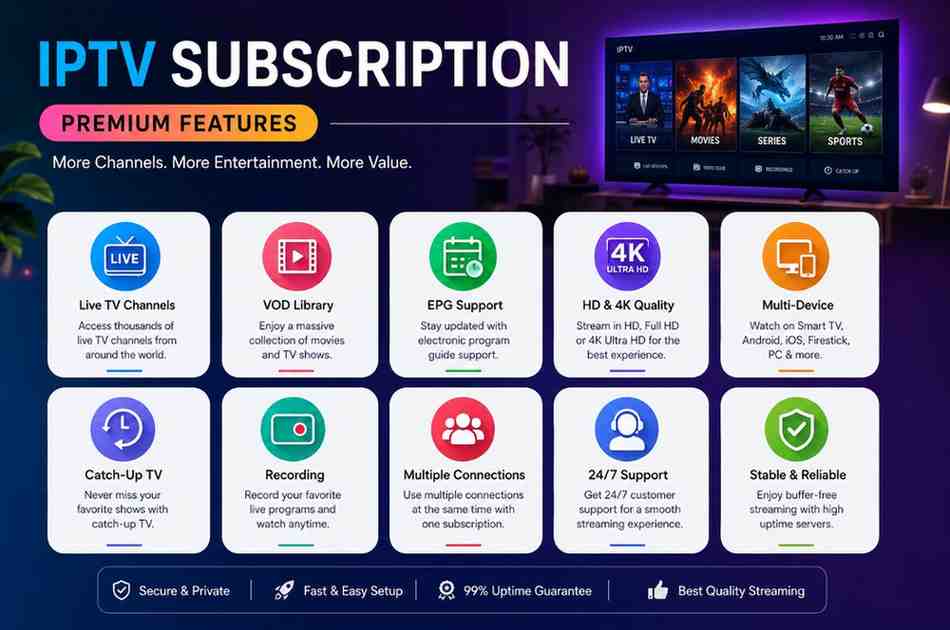
Buy IPTV subscription services — the short answer is yes, provided you choose a licensed, infrastructure-backed provider rather than a grey-market reseller. IPTV (Internet Protocol Television) streams live channels and on-demand content through your broadband connection, typically costing $10–$20 per month versus $80–$120 for cable. The real challenge is separating stable, legitimate services from providers that buffer constantly, disappear overnight, or resell stolen streams. This guide breaks down how IPTV works, what to verify before paying, and which buying strategy delivers the best long-term value.
buy iptv subscription Summary
A reliable IPTV subscription replaces expensive cable bundles with live TV, sports, and on-demand content delivered over the internet at 30–60% lower cost. The key is choosing a provider with stable infrastructure, legal content licensing, and responsive support.
| Optimal ForCord-cutters, expats, and sports fans seeking budget-friendly live TV with global channel access | Key AdvantageLive channels plus a full VOD library in one subscription, usable across TV, mobile, and tablet |
- ✓ Key Strength: Cost savings of 40–60% compared to traditional cable packages
- ✓ Key Strength: Instant activation with multi-device support (Smart TV, Android, iOS, Fire Stick)
- ✓ Peace of Mind: 24/7 support and service guarantee on verified official plans
In This Guide
What Is IPTV and How Does It Actually Work?
IPTV stands for Internet Protocol Television. Instead of receiving broadcast signals through coaxial cables, satellite dishes, or antennas, IPTV delivers television content as data packets over the same internet connection you use for browsing and streaming. That technical shift is what makes the pricing model so disruptive.
There are three primary content formats:
- Live television — real-time broadcast channels, including news, sports, and entertainment networks.
- Video on Demand (VOD) — movies and series stored on the provider's servers, available whenever you want.
- Time-shifted TV — catch-up TV that lets you replay programs from the last 7–30 days.
When you buy an IPTV subscription, you are essentially paying for access to the provider's IP backbone, content licensing agreements, and streaming infrastructure. On the technical side, you receive an M3U playlist URL or a dedicated application that organizes channels into an electronic program guide (EPG). The quality of that experience depends almost entirely on three factors: the provider's server capacity, the quality of their content licensing, and your internet connection stability.
It is critical to distinguish between licensed IPTV providers and unlicensed grey-market services. Licensed providers negotiate distribution rights with broadcasters and content owners. Grey-market services, which dominate search results, stream channels without authorization. They often offer 10,000+ channels for absurdly low prices, but they come with real risks: sudden shutdowns, legal exposure in some jurisdictions, malware-laden apps, and zero recourse when the service fails. A legitimate provider will be transparent about licensing, offer responsive support, and maintain stable infrastructure.

Pros and Cons: Real User Reports
Every IPTV buying decision comes down to trade-offs. Based on long-term user reports and service analysis, here is what you actually gain and what you risk when you buy IPTV subscription services.
✓ Pros
|
✗ Limitations
|
IPTV vs Cable vs Streaming: Key Metrics
To contextualize the value, here is a direct comparison of a typical IPTV subscription against cable TV and mainstream streaming platforms. These figures reflect verified market data from the 2026 provider landscape.
| Feature / Metric | IPTV Subscription | Cable TV | Mainstream Streaming |
|---|---|---|---|
| Monthly Cost | $10–$20 | $80–$120 | $15–$25 |
| Live Channels | 1,000–20,000 | 200–400 | 0–50 (limited live) |
| VOD Library | 5,000–50,000 titles | Limited | 10,000–20,000 titles |
| Contract Length | Month-to-month | 12–24 months | Month-to-month |
| Device Compatibility | Smart TV, mobile, tablet, PC | Set-top box only | Smart TV, mobile, tablet, PC |
| Streaming Quality | Up to 4K (varies) | Up to 1080p | Up to 4K HDR |
| Setup Time | 10–15 minutes | Professional install | 5 minutes |
Cost-Benefit Analysis: Is It Worth It?
Let's put real numbers behind the decision. The average cable bill in the U.S. is $102 per month — that is $1,224 per year. A quality IPTV subscription ranges from $10 to $20 per month, or $120–$240 per year. Even after adding a VPN at roughly $60 per year and a streaming device if needed at a $50 one-time cost, you save approximately $700–$900 annually.
The value calculation changes if you only watch Netflix and never need live TV. But for households that want live sports, news, and international channels, the math strongly favors IPTV. The break-even point is immediate — most IPTV providers activate service within minutes, meaning you can cancel cable the same day.
Hidden costs to watch for:
- VPN subscription if you want privacy protection and to prevent ISP throttling
- Hardware: Fire Stick, Android box, or a compatible smart TV app (one-time cost)
- Higher internet bandwidth: 25 Mbps minimum; 50+ Mbps recommended for 4K streams
When you buy IPTV subscription plans, always calculate the total cost of ownership — not just the sticker price. A $10/month plan that buffers constantly costs more in frustration than a $15/month plan with stable servers and working support.
Who Should Buy an IPTV Subscription?
IPTV is not for everyone, but it is an excellent fit for specific profiles:
- Cord-cutters: Households that already canceled cable and want live TV without the price tag.
- Expats and immigrants: People who want live channels from their home country.
- Sports fans: Fans who need access to regional and international sports networks.
- Budget-conscious families: Households that want broad channel access at a predictable low monthly cost.
- Tech-savvy users: People comfortable configuring apps and troubleshooting minor streaming issues.
If you fall outside these profiles — for example, you only watch Netflix originals and never watch live TV — a mainstream streaming subscription is likely a better fit. IPTV's value proposition is rooted in live content breadth and price, not in exclusive original programming.
Critical Buyer Considerations
Before you buy IPTV subscription services, run through this checklist to avoid the common pitfalls that lead to wasted money and terminated accounts:
- Verify licensing. Legitimate providers disclose their content sources. If a service claims 20,000 channels for $5/month, the content is almost certainly unlicensed.
- Test with a trial. Reputable providers offer 24-hour or 7-day trials. Use this window to test buffering, EPG accuracy, and channel availability.
- Read independent reviews. Search Reddit, Trustpilot, and forum discussions. Look for consistent complaints about downtime or support.
- Use secure payment. Credit cards and PayPal offer chargeback protection. Crypto-only payment is a red flag.
- Check device compatibility. Confirm the service supports your TV platform before purchasing.
- Understand the refund policy. A clear 7-day money-back guarantee signals confidence in the service.
- Consider a VPN. A VPN protects your privacy and can prevent ISP throttling.
One additional consideration: the provider's track record. Established providers with years of operation and verifiable uptime statistics are far safer bets than brand-new services with aggressive discount pricing. The grey-market IPTV space is notorious for churn — services launch, collect subscription fees, and vanish within months.
The Bottom Line on Iptv Subscription
If you want live sports, international channels, and on-demand content at roughly one-fifth of the cable cost, proceed with a verified provider. It is a solid, low-risk investment that pays for itself in the first month.
Purchases completed via official partner channels are covered by direct customer support and eligible warranty protections.
Frequently Asked Questions
Is buying an IPTV subscription legal?
IPTV itself is legal technology. The legality depends on whether the provider holds proper distribution rights. Licensed providers operate fully within the law. Unlicensed grey-market services violate copyright laws in most jurisdictions, and while enforcement typically targets providers rather than end-users, you still risk service loss and potential legal notices.
What internet speed do I need for stable IPTV streaming?
Standard definition requires at least 10 Mbps, HD requires 25 Mbps, and 4K content requires 50 Mbps or more. A wired Ethernet connection is more stable than Wi-Fi for consistent streaming. You should also ensure your plan has no low data caps, as IPTV can consume 30–50 GB per hour in 4K.
Can I use one IPTV subscription on multiple devices?
Most providers allow one concurrent stream per subscription, though premium plans often support 2–4 simultaneous connections. You can typically install the app on unlimited devices, but only the allocated number can stream at the same time. Check this before buying if you have a multi-TV household.
What channels are typically included in an IPTV package?
Packages vary by provider, but most include local broadcast networks, major cable news channels, sports networks, entertainment channels, and international options. Premium sports and movie channels may require add-ons. The EPG should list all available channels before you purchase.
How do I set up an IPTV subscription on my TV?
Setup takes 10–15 minutes. After purchase, you receive an M3U playlist URL or activation code. On Smart TVs, you install the provider's app or a compatible player like IPTV Smarters, enter your credentials, and the channel list populates automatically. Fire Stick and Android boxes follow a similar process.
Do IPTV providers offer free trials?
Reputable providers offer 24-hour free trials or 7-day money-back guarantees. Use the trial to test channel availability, buffering during peak hours, and EPG accuracy. A provider that refuses any trial is a significant red flag.
What happens if my IPTV provider goes offline permanently?
This is the biggest risk with unlicensed providers. If the service shuts down, you lose your remaining subscription time with no recourse. Licensed providers with established infrastructure rarely fail, which is why choosing a verified provider matters more than chasing the lowest price.
How much should I expect to pay for a reliable IPTV subscription?
Quality IPTV subscriptions range from $10 to $20 per month. Annual plans often reduce the effective monthly cost to $8–$12. Prices below $5 per month should raise concerns about licensing and infrastructure. The cheapest option is rarely the most economical in the long run.
Transparency & Disclosure: We independently evaluate products. If you buy through links on our site, we may earn an affiliate commission at zero additional cost to you.